Ukraine, EU Independence & How to Help (UNITED24) | CyclOrbit
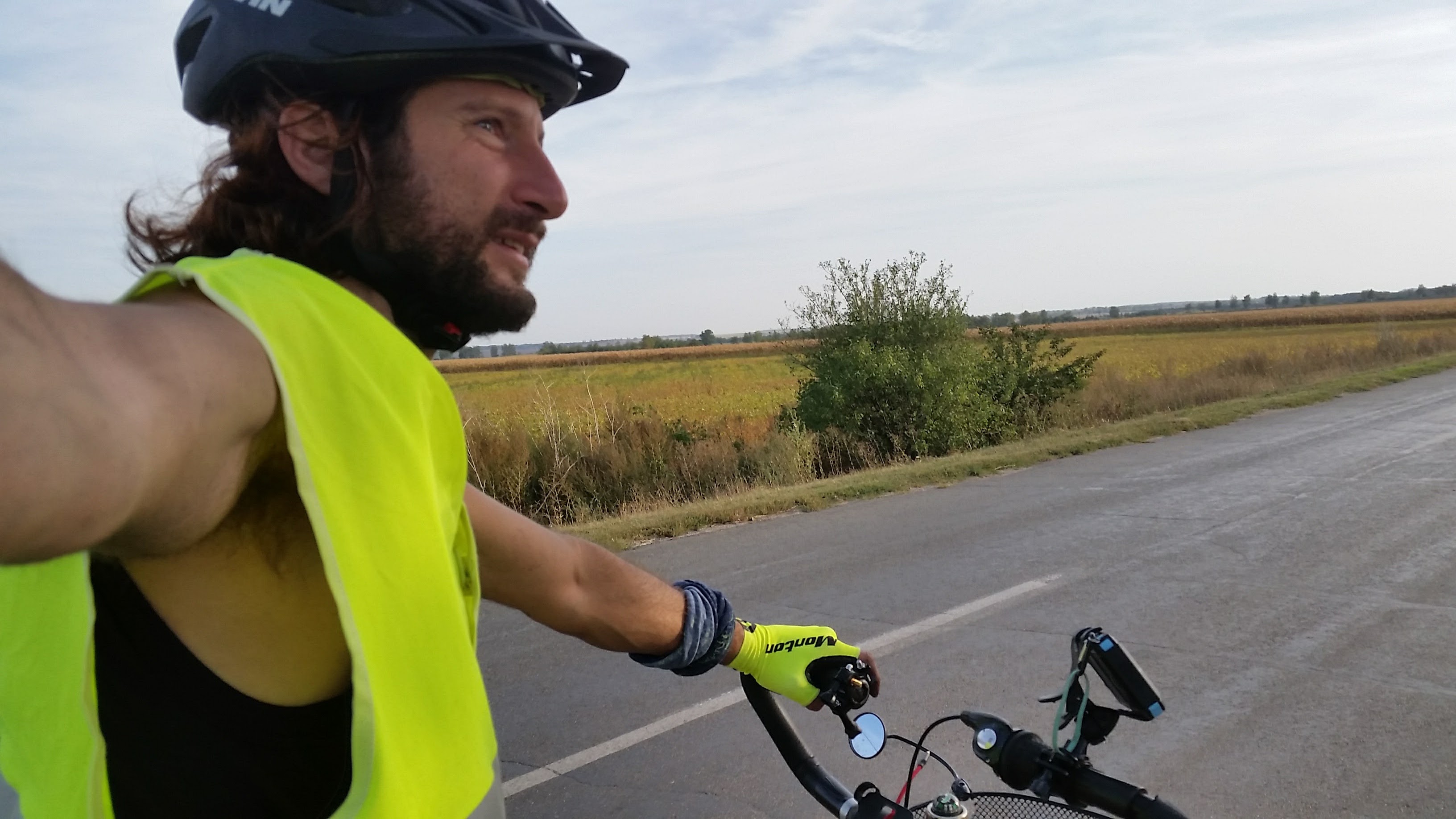
I spent three months travelling through Ukraine by bicycle.
That is why Ukraine is not just a shape on a news map for me. It is a country I crossed slowly, covering the distance on two wheels rather than scrolling past it.
And there is one memory that belongs in this story.
While travelling from Ukraine to Georgia by ferry from Odesa to Batumi, Russian helicopters aggressively circled the ship I was on. I experienced it as intimidation. I cannot tell you what orders the crews had received, but I can describe how their behaviour appeared from the ferry.
I was travelling from one country to another. Their presence turned that ordinary journey into something else: a reminder that somebody else’s military power could intrude into the space around us.
I was a traveller who could leave. That is an important difference from the people whose homes and futures remain at stake.
Now, when I read about uncertain intelligence sharing, restricted satellite services and decisions easing economic pressure on Russia, that memory returns.
For me, this is about Ukraine. But it is also about Europe—and whether we are prepared to take responsibility for our own security.
🛰️ What happened to Ukraine’s satellite access?
“Ukraine left without satellites” is a powerful headline. It also merges different systems and disputed events into one misleading picture.
One issue concerns US intelligence sharing. President Volodymyr Zelensky said cooperation had resumed after a pause. US Secretary of State Marco Rubio denied that a pause had occurred [1]. That disagreement matters: an alleged interruption should not become an undisputed three-day blackout through repetition.
A separate issue concerns restrictions affecting SpaceX satellite services [2] used by Ukrainian forces. Ukraine reported that limits on satellite terminals disrupted drone missions before access improved. This was not the same as switching off every satellite connection across the country.
Satellite communications and intelligence are different capabilities. Neither can simply be replaced by saying, “Use another internet provider.”
The underlying problem is serious enough without exaggeration: essential capabilities can depend on decisions made outside the country that needs them.
An ally’s support matters. But support that can become uncertain is not the same as having the capacity to act independently.

⚖️ Washington eased economic pressure on Russia
On October 16, President Donald Trump signed an executive order putting on hold [3] a sweeping package of new Russia-related sanctions and tariffs under the Graham Act. This did not abolish every existing American sanction, but it prevented major new penalties from taking effect [4].
Separately, the US Treasury issued General License 135 [5], authorising certain transactions involving Russian-origin diesel. Reporting describes that permission as extending through April 2027 [6].
This was not a direct US government cash transfer to Moscow. We should not describe it as one.
But easing restrictions on Russian trade is an economic choice with consequences. The waivers prompted criticism that Washington was relieving pressure on Russia while its war against Ukraine continued.
“Abandonment” is a political judgement. Restrictions, licences and waivers are concrete decisions we can examine.
For me, the troubling combination is uncertainty over support for Ukraine alongside relief from economic pressure on Russia.
🇪🇺 Europe needs independence, not another promise
My conclusion is straightforward: the European Union must become capable of acting without US permission.
Not because every American administration is the same. Not because cooperation with the United States has no value. And certainly not because ordinary Americans are our enemies.
We need independence because security should not depend on the next election in another country.
By independence, I mean autonomy: the ability to maintain essential services, defend democratic choices and act when a partner disagrees, withdraws or changes direction.
That does not mean producing everything inside the EU or cutting ourselves off from the world. It means avoiding dependencies that leave somebody else holding the decisive switch.

1. Satellites, intelligence and defence
Europe should be able to maintain secure communications, gather and assess intelligence, coordinate its forces and sustain its defence—even when Washington chooses not to participate.
That requires more than announcements. My priorities would include European-controlled satellite capacity, stronger intelligence cooperation, interoperable military equipment, dependable production and procurement, and the ability to maintain systems without a foreign veto.
There is already work in this direction. The EU’s IRIS² programme [7] is designed to provide secure, sovereign satellite communications [8] for governments, defence, emergency services and other users. But it remains a programme being developed, not a complete replacement available today.
Nor should we confuse a secure communications constellation with an entire intelligence or defence architecture. Building one part of independence does not finish the job.
2. Social media and the public conversation
The same principle should apply to the spaces where we exchange information.
I do not want Europe’s public conversation to depend entirely on platforms whose rules, priorities and ownership we cannot meaningfully influence.
My answer is not a government-controlled European social network. It is more choice: interoperable services, open standards, independent moderation, meaningful user rights and the practical ability to leave a platform without losing every connection.
A European flag on a closed platform would not solve the underlying problem. Accountability and freedom to move matter too.
3. IT, cloud services and essential infrastructure
For public administration, healthcare and other essential services, I want European institutions to ask a basic question before signing a contract:
Can we continue operating if this provider becomes unavailable—or if its government’s priorities change?
That means planning for portability, backups, cybersecurity, alternative suppliers and realistic exit routes. It also means investing in European expertise and open-source options where they are suitable.
Independence is not achieved by changing a supplier’s logo. It is achieved when switching suppliers is genuinely possible.
4. Payments and financial infrastructure
Money belongs in this discussion too.
The European Central Bank has explicitly warned [9] that excessive reliance on a small number of non-European payment providers creates vulnerabilities, including the possibility of payment services becoming instruments of economic or political leverage.
This does not mean that all European or international payments are controlled by the United States. The dependency varies by system. But in retail and card payments, European authorities have identified a significant reliance on non-European networks and processors [10].
My position is that people and businesses in Europe should have reliable, widely accepted ways to pay that operate under European governance—including across borders.
Cooperation with international providers can continue. It should be a choice, not our only workable option.
🤖 Russian bots: another form of dependence
Infrastructure is not the only vulnerability. Our attention can be manipulated too.
European investigations have documented Russian information operations [11] involving fake accounts, websites impersonating established news organisations and coordinated networks distributing pro-Kremlin material. Some operations have involved Russian state bodies or organisations linked to them.
“Bots” is a convenient shorthand, but the system is broader. Automated accounts can operate alongside human-run profiles, state-controlled media and apparently independent websites. European and Ukrainian investigators have described coordinated amplification, AI-generated content and “information laundering” [12]—passing claims between outlets to make them appear independently confirmed.
The goal is not always to make us admire Russia. Documented campaigns have also sought to demoralise Ukrainians, damage relationships with European neighbours and portray support for Ukraine as harmful or futile [13].
Nothing helps. Everyone lies. Every donation is wasted. Why bother?
That is a useful conclusion for anyone who wants solidarity to disappear.

Disagreement is not proof of a bot
Someone criticising this article is not automatically a Russian operative. Questioning a government, a fundraiser or a military policy can be legitimate.
The distinction is organised deception—not whether I like the opinion.
My personal connection to Ukraine does not make me immune to manipulation either. If I share something inaccurate because it supports my argument, it is still inaccurate.
I want this blog to do the opposite: distinguish evidence from interpretation, acknowledge uncertainty and correct mistakes.
🇺🇦 A verified place to help: UNITED24
Political independence is a long-term project. Helping Ukraine does not have to wait for it.
One verified starting point is UNITED24 [14], Ukraine’s official fundraising platform, established as an initiative of the President of Ukraine. Its official government website provides donation routes and weekly reporting on fund distribution.
The platform lists separate areas of support, including:
- Defence
- Humanitarian demining
- Medical aid
- Rebuilding Ukraine
- Education and science
- Sports development
That distinction matters. Someone seeking to support civilian healthcare should be able to choose that purpose; someone choosing defence should understand that category too.
“Verified” here means that this is the official platform and that it publishes reporting—not that a government label removes the need to read the details.
Go directly to the official website, check the current appeal and reporting, and choose the area you want to support. I would rather point readers towards a clearly identified platform than circulate an emotional appeal whose destination I cannot establish.
🚲 And yes, bicycles still belong here
After spending three months cycling through Ukraine, I cannot leave bicycles out of this story.
For me, a bicycle is usually a tool of freedom: choose a direction, carry what you need and go. But it is also something more ordinary and practical—a way to get somewhere.
If you want to support a bicycle collection for Ukraine, begin with the organiser’s current needs. Ask which bicycles are accepted, whether they must be road-ready and how transport is arranged.
Do not assume that donating an unwanted bicycle is automatically useful. The right question is not “What can I get rid of?” but “What does this project actually need?”
That might be a bicycle. It might be requested parts, repair work or money towards a defined expense. Practical solidarity is not always photogenic. It still counts.

🌊 What I brought back from the Black Sea
I keep returning to that ferry between Odesa and Batumi.
I do not need to make the memory more dramatic than it was. Russian helicopters aggressively circled the ship I was travelling on. I experienced their behaviour as intimidation.
I cannot tell you their intentions. I can tell you why I remember it.
It made military power feel immediate—not something confined to speeches or distant maps, but something intruding into a civilian journey.
And it reminds me to keep my own experience in proportion. I was passing through. Ukrainians do not have the same option of treating their country’s security as an episode in a travel story.
🤝 Solidarity needs both people and institutions
I cannot switch an intelligence feed back on. I cannot negotiate sanctions or build a satellite constellation.
But I can support a verified appeal. I can refuse to amplify fabricated stories. I can ask European representatives to take responsibility for the infrastructure and capabilities our societies depend on.
And I can keep paying attention after Ukraine drops out of the headlines.
Europe needs the capacity to defend itself, maintain its communications, protect its information space and keep essential digital and financial services working. That is not an argument against friendship with the United States. It is an argument against helplessness.
Ukraine needs dependable partners, not sympathy that expires when politics becomes inconvenient.
I spent three months crossing Ukraine on two wheels. My journey ended. My interest did not.
📚 Sources & References (Click to Expand)
- Euronews: Marco Rubio denies there was any pause in US intelligence sharing with Ukraine
- The Hill: Ukraine faces grim question of whether it can take on Russia without US backing
- The White House: Implementing the Lindsey O. Graham Sanctioning Russia and Iran Act of 2026
- ABC News: Trump puts new Russia sanctions passed by Congress on hold
- US Department of the Treasury (OFAC): Issuance of Russia-related General License 135
- ABC News: Trump signs order waiving Graham Act sanctions on Russia
- EU Space Policy: IRIS² Secure Connectivity Programme
- European Space Agency (ESA): ESA Programme Related to EU Secure Connectivity – IRIS²
- European Central Bank (ECB): The Eurosystem’s comprehensive payments strategy
- European Central Bank (ECB): Report on card schemes and processors (PDF)
- European External Action Service (EEAS): Information manipulation in Russia’s war of aggression against Ukraine
- European External Action Service (EEAS): New joint report exposes Russian attempts to derail Ukraine’s EU membership
- European External Action Service (EEAS): Results of pro-Russian information manipulation monitoring
- UNITED24: Official Fundraising Platform of Ukraine & Impact Reports